Why 95% of B2B Buyers Aren’t Ready Yet | Demand Creation Strategy
Most B2B buyers aren’t ready to purchase today. Learn how the 95/5 rule helps brands balance demand capture and demand creation for long-term growth.
Article
May 18, 2026
Author - Mohana J

There's a hard truth that most B2B marketing teams quietly ignore: the overwhelming majority of people you're trying to reach have zero intention of buying from you right now. Not because your product isn't good, not because your messaging is off, simply because they're not in the market yet.
This is the foundation of the 95/5 rule, a concept backed by research from the Ehrenberg-Bass Institute and championed by marketing scientists like Professor John Dawes. The premise is deceptively simple and the implications are enormous.
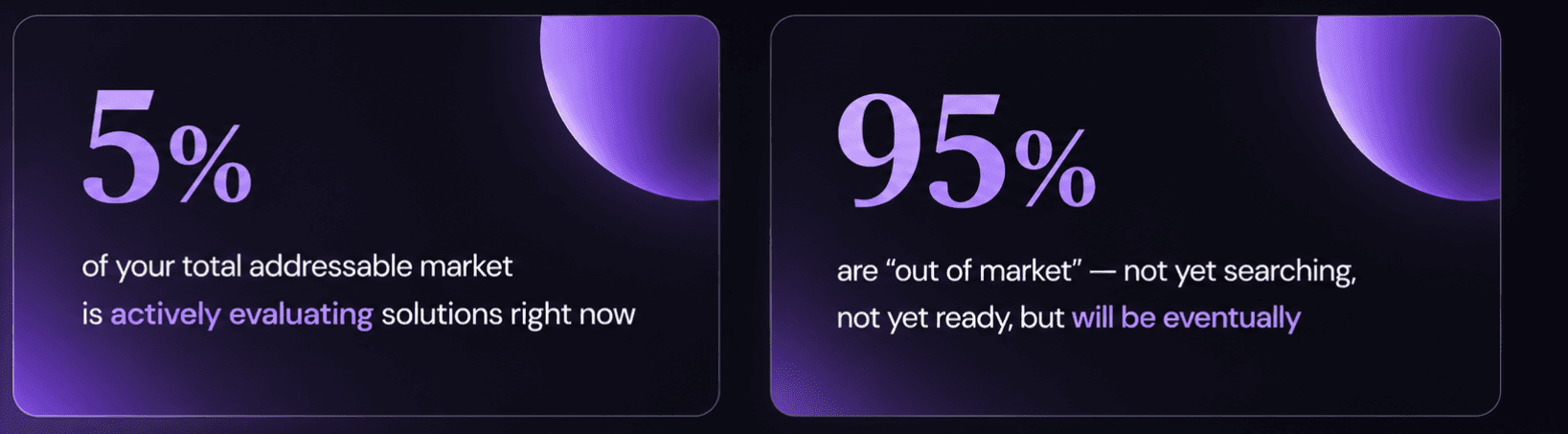
The research is consistent across industries. Whether you're selling enterprise software, cloud infrastructure, or logistics services, only a small fraction of your potential clients are in an active buying cycle at any given moment. The rest are locked into existing contracts, haven't recognized the problem yet, or simply have other priorities this quarter.
"Most proactive sales and marketing efforts are targeting a tiny slice of the total addressable market but that's where the opportunity lies, not in ignoring the larger 95%, but in integrating them into your long-term strategy."
Why Your Ads Aren't Working the Way You Think
Here's a painful finding from LinkedIn's B2B Institute: 96% of B2B marketers expected their advertising campaigns to show a significant impact within two weeks. Two weeks. For an audience that evaluates new vendors every three to five years.
This mismatch is the root cause of so much wasted budget, so many campaigns written off as failures, and so many marketing teams under constant pressure to justify spend that was never designed to convert immediately in the first place.
Advertising in B2B rarely works by creating instant demand. It works by building what researchers call mental availability, planting your brand into the memory of buyers long before they enter the market. When that moment eventually arrives, the brands that win are the ones that were already familiar, already trusted, already top of mind.
That's a fundamentally different job description for marketing. And most teams aren't staffed, budgeted, or measured for it.
Two Strategies, One Goal
Understanding the 95/5 rule leads to a strategic split that separates high-performing B2B organisations from those perpetually chasing their tails. It comes down to the difference between demand capture and demand creation.
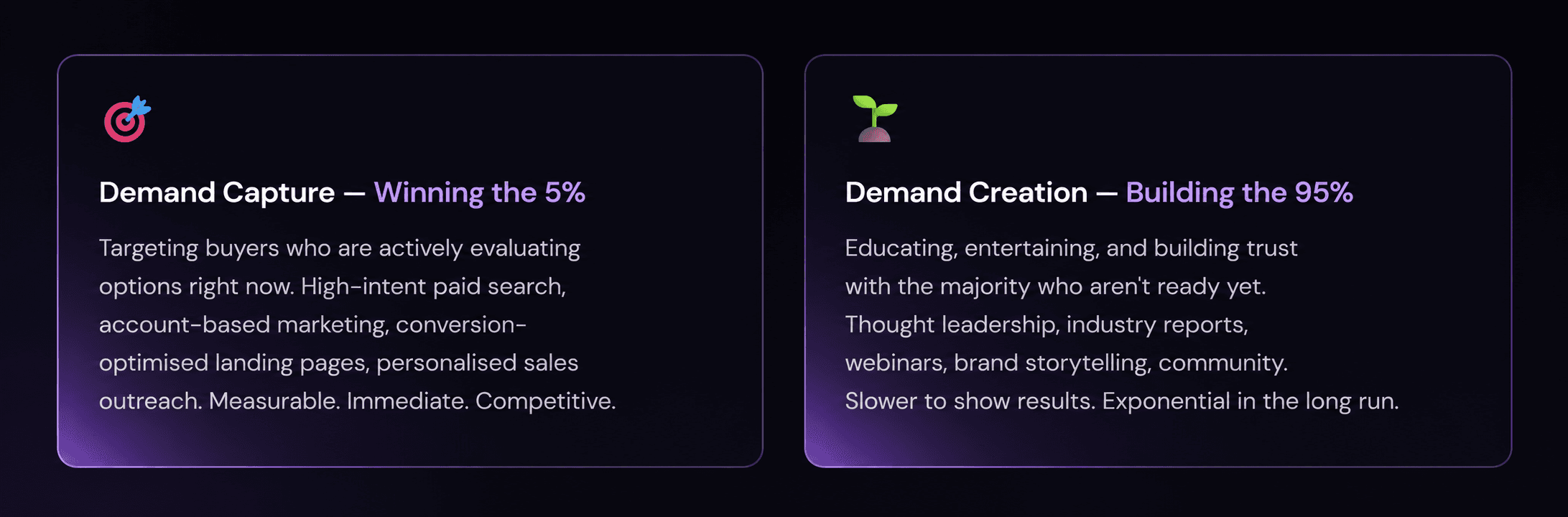
Most B2B companies invest almost exclusively in demand capture. They optimise for the 5%. The result? Fierce competition for a small pool of buyers, skyrocketing cost-per-acquisition, and a pipeline that runs dry the moment ad budgets get cut.
The brands winning long-term are investing in both, but they're leaning heavily into creation. They're showing up before the buying window opens, not scrambling to catch up once it does.
What Engaging the 95% Actually Looks Like?
This isn't about sending more emails or posting more LinkedIn content. Genuinely engaging the out-of-market majority requires a shift in how marketing communicates. Instead of "here's why you should buy from us," the message becomes "here's something that makes your work easier, your thinking sharper, your industry clearer."
Content That Educates, Not Pitches
Thought leadership is the engine of demand creation. Industry insight reports, benchmark studies, webinar series exploring sector-wide challenges, these are assets that future buyers consume months before they type a competitor comparison into Google. When your brand is the one that taught them something valuable, you enter the consideration set by default.
Build a content hub with ungated educational resources like frameworks, playbooks, research summaries
Host roundtables and expert interviews that position your brand as a category facilitator, not just a vendor
Develop free diagnostic tools like calculators, scorecards, assessments that create daily utility
Run a podcast or video series featuring voices your audience already respects
Publish case studies that focus on outcomes over time, not just conversion moments
Smart SDR Outreach for Non-Buyers
Sales Development Representatives don't have to sit idle while marketing nurtures the 95%. They can play an active role but the playbook looks different. Rather than pushing for demos, the goal is pre-qualification: open-ended conversations that uncover business timelines, surface obstacles, and map the landscape of future need. Lead with a useful resource. Ask a smart question. Leave a positive impression. Score that engagement and revisit when the signals change.
Brand Awareness Ads That Don't Try to Close
Instead of product ads targeting bottom-funnel audiences, shift a portion of your ad spend toward thought leadership creative, research insights, industry trend pieces, perspective-driven content, running on LinkedIn and YouTube. You're not asking for a click. You're creating a memory. And memory is what drives consideration when the time finally comes.
How to Split the Budget?
A framework that resonates with demand generation leaders: invest roughly 70% of marketing resources in demand creation and 30% in demand capture. It runs counter to how most B2B budgets are built, but it reflects the actual shape of the market.
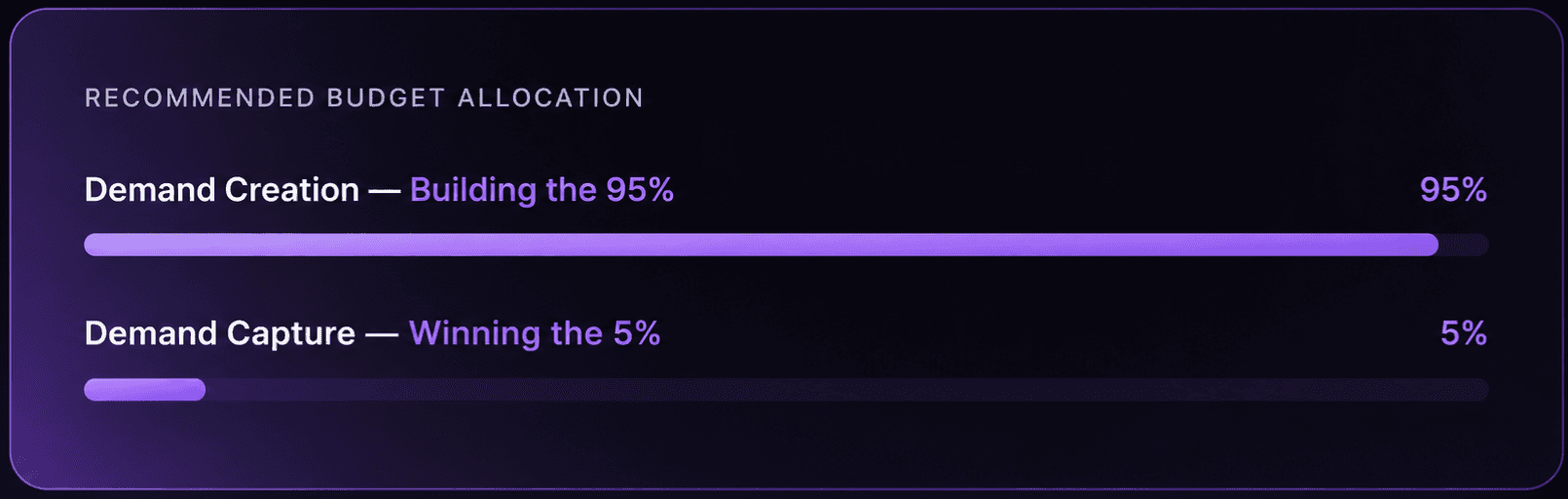
The 30% in demand capture still matters, it's what drives near-term pipeline and gives leadership the short-term metrics they need. But the 70% in demand creation is what builds the brand moat. It's what makes your future pipeline less dependent on whoever is in market today and more shaped by the trust you've built across an entire industry.
Measuring What Doesn't Convert (Yet)
One of the biggest blockers to investing in the 95% is measurement. How do you prove ROI on content that won't produce a closed deal this quarter? The honest answer is: you expand your definition of success.
Track engagement with educational content like time on page, repeat visits, webinar attendance, newsletter open rates. Monitor lead scoring shifts over time. Run brand recall surveys. Watch for accounts moving from cold to warm without ever clicking a conversion ad. These are the signals that the 95% is moving, even when the CRM isn't lighting up.
The best marketing teams build two dashboards: one for demand capture (the familiar conversion metrics) and one for demand creation (reach, engagement, brand affinity, share of voice). The second dashboard is harder to defend in a quarterly business review. It's also the one that explains why your pipeline looks so healthy two years from now.
The Long Game Is the Growth Game
The 95/5 rule isn't a reason to write off most of your market. It's an invitation to engage them on different terms. The brands that plant seeds now through genuine education, consistent visibility, and trust built over time are the ones that find the buying conversation already half-won when a prospect finally enters the market.
Stop fighting over the 5%. Start owning the 95%.
Your Buyers Are Searching, Will They Find You?
Let’s build a marketing strategy that drives visibility, trust and inbound leads.