AI Brand Visibility: How to Track and Grow Your Presence in AI Search
Discover how to measure brand mentions, citations, and share of voice across AI search engines and assistants. Learn how to increase your brand visibility beyond traditional SEO.
Article
Feb 13, 2026
Author - Mohana J
Explore how modern tools help you see, understand, and grow your brand presence where people are really searching
In 2026, brand visibility isn’t only about ranking in Google anymore. People are asking questions directly to AI assistants, chatbots, and knowledge engines and if your brand doesn’t show up there, you might as well be invisible. This is where next-generation visibility tracking comes in: letting you measure brand presence across AI search answers, videos, forums, and search trends in one place.
Today, let’s break down how these insights work, why they matter, and how you can use them to grow your brand awareness in ways traditional SEO never could.
The Old Search Funnel Is Disappearing
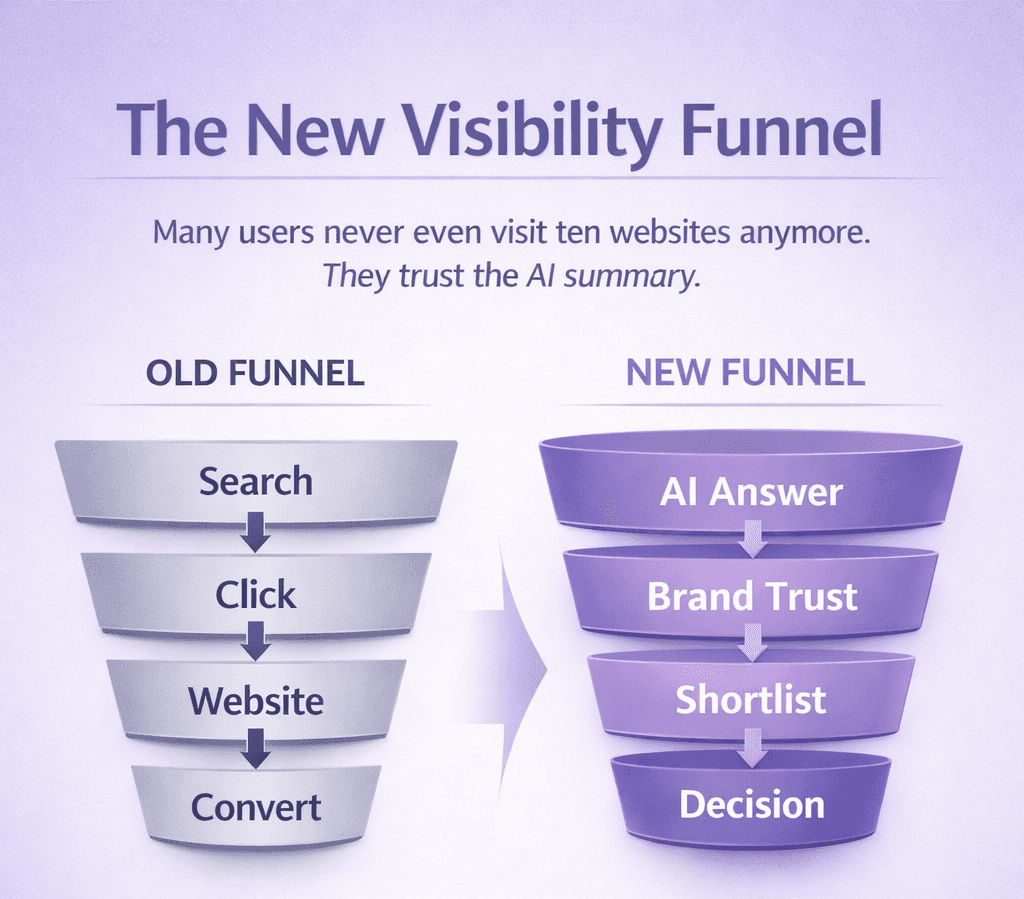
For years, digital growth followed a simple pattern:
Search → Click → Website → Convert
Now the flow looks more like:
AI Answer → Trust → Shortlist → Decision
In many cases, users never even visit websites. They trust the AI summary. Whoever the AI mentions becomes the brand they remember.
How AI Actually Forms Brand Recommendations?
Let’s break this down carefully. AI systems don’t “browse” the internet like humans.
They do three major things:
Absorb large volumes of content
Detect patterns and relationships
Generate answers based on probability and trust
When AI repeatedly sees:
Brand A mentioned in authoritative blogs
Brand A compared favorably in SaaS reviews
Brand A discussed in expert communities
Brand A associated with a specific problem
It starts forming an internal relationship model:
Brand A = credible solution for X problem.
That relationship strengthens every time it sees reinforcement. Over time, Brand A becomes a “safe recommendation.” That’s what visibility now means.
This means visibility no longer happens only in rankings. It happens inside AI narratives.
What AI Brand Visibility Actually Means?
AI Brand Visibility is how often and how positively your brand appears inside:
• AI answers (ChatGPT, Gemini, Copilot, Perplexity)
• Brand recommendations
• Citations and references
• Comparisons and shortlists
Instead of competing for page one of Google, you’re competing for:
✔ Being mentioned
✔ Being trusted
✔ Being framed as the right choice
Why This Matters More Than Traditional SEO Now?
Traditional SEO optimizes for traffic. AI visibility optimizes for influence.
Traditional SEO | AI Visibility |
|---|---|
Ranks webpages | Shapes answers |
Optimizes keywords | Optimizes brand presence |
Chases clicks | Builds trust |
Measures traffic | Measures mentions |
In AI-driven discovery, being referenced beats being ranked.
How AI Systems Decide Which Brands to Show? (And Why Some Always Win)
AI search engines don’t work like Google rankings. They don’t simply crawl pages and list results.
Instead, they synthesize knowledge across millions of sources to decide which brands feel trustworthy, relevant, and helpful enough to include in an answer. Think of it less like “search” and more like reputation modeling at internet scale.
Let’s break down the main signals AI uses.
1. Brand Presence Across the Web (Digital Footprint Strength)
AI models constantly learn from:
• Blog articles
• Reviews and testimonials
• News coverage
• Reddit and forum discussions
• Product comparisons
• Industry reports
The more consistently your brand appears across credible sources, the more likely AI sees you as:
Established
Relevant
Worth recommending
A brand mentioned once on its own website looks invisible. A brand referenced across dozens of independent sources looks trustworthy.
Consistency beats volume. Ten authoritative mentions matter more than hundreds of low-quality ones.
2. Authority of the Sources That Mention You
Not all mentions carry equal weight.
AI gives more importance to:
✔ Well-known publications
✔ Industry blogs with strong reputations
✔ Educational sites
✔ Research-driven content
✔ High-engagement communities
If respected platforms frequently cite your brand, AI learns:
“This brand is a reliable source in this topic area.”
This is why PR, guest content, partnerships, and expert quotes now directly influence AI visibility.
3. Topical Depth (Not Just Keywords)
AI doesn’t think in keywords. It thinks in topics and relationships.
Instead of:
“Does this page rank for CRM software?”
AI asks:
“Which brands deeply cover customer relationship management, sales workflows, automation, onboarding, and analytics?”
Brands that publish:
• In-depth guides
• How-to content
• Frameworks
• Original insights
• Structured explanations
Become associated with entire topic clusters. Once that association is strong, AI naturally pulls them into related answers. This is why shallow blog posts rarely get cited.
4. Brand Sentiment & Trust Signals
AI also evaluates how people talk about you.
It picks up:
• Positive reviews
• Problem-solving experiences
• Complaints
• Praise
• Comparisons
Over time, models learn patterns like:
“Users frequently recommend this brand.”
“This product solves X problem well.”
“This company has reliability issues.”
Strong positive sentiment increases recommendation likelihood. Consistent negative narratives reduce visibility.
In short: your reputation is now machine-readable.
5. Clarity of What You’re Known For
AI favors brands with a clear positioning.
If your content, mentions, and messaging consistently reinforce:
“We are the best for X problem”
AI understands exactly when to surface you. But if your brand talks vaguely about many things, AI struggles to categorize you.
Clear niche authority beats broad generic messaging every time.
6. Content Structure That AI Can Easily Summarize
AI systems prefer content that is:
✔ Well organized
✔ Clearly explained
✔ Structured with headings
✔ Focused on answering questions
Pages that explain concepts step by step, compare options clearly, and define terms precisely are much easier for AI to reference.
Messy, sales-heavy pages are often ignored.
7. Competitive Context
AI doesn’t evaluate brands alone. It constantly compares.
It looks at:
• Who gets mentioned most for a topic
• Who receives positive sentiment
• Who appears in expert content
• Who users recommend
Then it surfaces the strongest perceived authorities.
This is why once a few brands dominate AI answers, they tend to keep winning unless others actively build authority.
The Big Picture: AI Is Building a Reputation Graph
Rather than ranking pages, AI is building something closer to a brand reputation map of the internet.
It connects:
Brand → Topics → Trust → Sentiment → Authority → User Preference
And recommends brands that sit strongest in those relationships.
Understanding how AI perceives your brand is the first step to improving it. A short strategy call can uncover exactly where you stand and what to fix.
Your Buyers Are Searching, Will They Find You?
Let’s build a marketing strategy that drives visibility, trust and inbound leads.