The Only 3 B2B Marketing Channels That Matter in 2026
You don't have a channel problem. You have a focus problem. Here's where sustainable B2B pipeline actually comes from now, and why spreading thin across a dozen channels is quietly working against you.
Article
Jul 26, 2026
Author - Mohana J

Every quarter, a new channel gets crowned the future of B2B marketing. Last year it was short-form video. Before that, it was community-led growth. Right now, everyone's arguing about whether LLM citations are the new backlinks. Meanwhile, most B2B SaaS teams I work with are stretched across seven or eight channels at once, doing all of them at 40% effort and wondering why pipeline feels unpredictable.
Here's the uncomfortable but freeing truth: in an AI-first buying landscape, only a handful of channels compound. Everything else is either a short-term spike or a distraction dressed up as a strategy. This isn't a "kill all your channels" argument, it's a resource allocation argument. If you have limited budget and a small team, three channels deserve the majority of your attention: organic search and AI search visibility (SEO + GEO/AEO), owned audience and email, and thought leadership with social distribution. Here's why, and how to actually execute on each.
Why the Old Channel Playbook Is Breaking?
Three shifts are reshaping how B2B buyers research and decide, and most marketing strategies haven't caught up.
Buyers Are Researching Through AI, Not Just Google
Buyers increasingly ask an AI assistant to summarize or shortlist options before they ever visit a vendor's site. That means your visibility now depends on whether LLMs cite, reference, or recommend you, not just whether you rank on a search results page. This is the entire premise behind GEO (Generative Engine Optimization) and AEO (Answer Engine Optimization): structuring content so it gets pulled into AI-generated answers.
Zero-Click Search Is the New Normal
A growing share of searches now end without a click at all, the answer is served directly in the search result or an AI overview. This doesn't make SEO less valuable, it changes what "winning" a search looks like. Ranking #1 for a query that gets zero-clicked delivers brand visibility and trust, even without direct traffic, which is why entity building and topical authority matter as much as click-through rate now.
Paid Ads Alone Don't Compound
Paid acquisition still has a role, but relying on it as your primary engine is increasingly fragile. Costs keep climbing, ad fatigue sets in faster, and the moment budget stops, pipeline stops with it. Paid works best as an accelerant on top of organic and owned assets that are already generating trust, not as a replacement for them.
The core shift: Trust used to be built at the point of a sales call. Now it's built (or lost) long before a buyer ever talks to you, through what they find when they search, what an AI assistant tells them, and what your existing customers say in public.
Channel 1: Organic Search & AI Search Visibility (SEO + GEO/AEO)
This channel remains the foundation because it captures buyers at the exact moment of intent, whether that intent is expressed to Google or to an AI assistant.
Why It Matters in 2026?
Search-driven discovery, human or AI-mediated, is still where most B2B buying journeys begin. The difference now is that ranking on page one isn't the only goal; being the source an LLM cites when someone asks "what's the best tool for X" is becoming equally important for pipeline generation.
Common Mistakes
Optimizing only for keyword rankings and ignoring how content gets structured for AI extraction (clear answers, defined entities, structured data)
Publishing content without a clear point of view, which is easy for competitors and AI models to say the exact same thing about
Treating technical SEO as a one-time project instead of ongoing hygiene
No internal linking strategy connecting product pages, comparison pages, and blog content into topical clusters
What Makes It Effective?
Strong organic growth engines are built on topical authority (comprehensive coverage of a subject, not scattered one-off posts), original perspective (data, frameworks, or opinions AI models and readers can't get elsewhere), and technical foundations (crawlability, schema, page speed) that let search engines and AI crawlers actually parse your content correctly.
Key metrics to track
Organic traffic and keyword rankings for buyer-intent terms (not just volume)
Share of AI citations or brand mentions in tools like ChatGPT, Perplexity, and Google AI Overviews
Assisted conversions from organic (not just last-click)
Time to rank and content decay rate across your existing library
Actionable Strategy
Audit your top 20 pages for AI-extractability: clear headers, direct answers near the top, structured data
Build 2–3 pillar topics with full supporting clusters instead of publishing disconnected posts
Add original data, frameworks, or opinionated takes that AI models can't easily paraphrase from a competitor
Monitor brand mentions across AI search tools monthly, not just Search Console
Channel 2: Owned Audience & Email
Why It Matters in 2026?
Every platform you don't own can change its algorithm, its rules, or its reach overnight. Your email list, and increasingly your community or newsletter audience, is the one channel where you control distribution completely. As first-party data becomes more valuable (and third-party tracking keeps eroding), the businesses with a direct line to their audience have a durable advantage competitors can't easily replicate.
How Buyer Behaviour Has Changed?
B2B buyers are more skeptical of outbound and more responsive to content they've opted into. A newsletter someone chose to subscribe to carries more trust than a cold email, and that trust translates directly into pipeline quality when it's time to convert.
Common Mistakes
Treating email as a broadcast channel for product announcements instead of a relationship-building asset
No segmentation, sending the same message to a free trial user and a champion who's used the product for two years
Growing the list without a retention strategy, so churn quietly cancels out growth
Ignoring engagement metrics until deliverability problems already show up
Key metrics to track
List growth rate alongside engagement rate (not growth alone)
Open and click-through rate by segment, not blended averages
Email-attributed pipeline and reply rate on nurture sequences
Unsubscribe and spam complaint rate as an early warning signal
Actionable Strategy
Build one clear reason to subscribe (a specific angle, not "get our updates")
Segment your list by lifecycle stage at minimum: prospect, trial user, customer, churned
Write for the subscriber's inbox, not your content calendar, shorter, more direct, one idea per email
Use email to distribute your best organic and thought leadership content, don't create a third content stream from scratch
Channel 3: Thought Leadership & Social Distribution
Why It Matters in 2026?
B2B buying has become more community-driven. Buyers trust the opinions of practitioners and founders they follow more than brand messaging, and platforms like LinkedIn have become de facto research tools where buyers vet vendors by looking at what the people behind the product actually say publicly.
What Makes It Effective?
Thought leadership works when it's genuinely opinionated and specific, not recycled industry commentary. The founders and marketers who build real pipeline through social aren't posting generic tips, they're sharing what they're actually seeing in their business, including the uncomfortable parts, which is exactly what makes it credible.
Common Mistakes
Posting company updates dressed up as thought leadership, nobody engages with "excited to announce"
Inconsistent posting that stalls momentum right as an audience starts forming
No distribution plan for content beyond the original platform post
Founders and PMMs waiting for "the perfect insight" instead of publishing consistently and refining over time
Key metrics to track
Engagement rate and saves/shares (stronger buying signals than likes)
Follower growth among your actual ICP, not vanity audience size
Inbound DMs, comments, or connection requests that convert to conversations
Website or demo traffic attributed to social referral
Actionable Strategy
Pick one founder or subject-matter expert to be the consistent voice, don't split thin across five people
Repurpose your best organic content (Channel 1) into opinionated social posts instead of creating from scratch
Share specific results, frameworks, or contrarian takes, not generic advice available everywhere
Reply to every substantive comment, the comment section is where trust actually gets built
Where the Three Channels Compound Together?
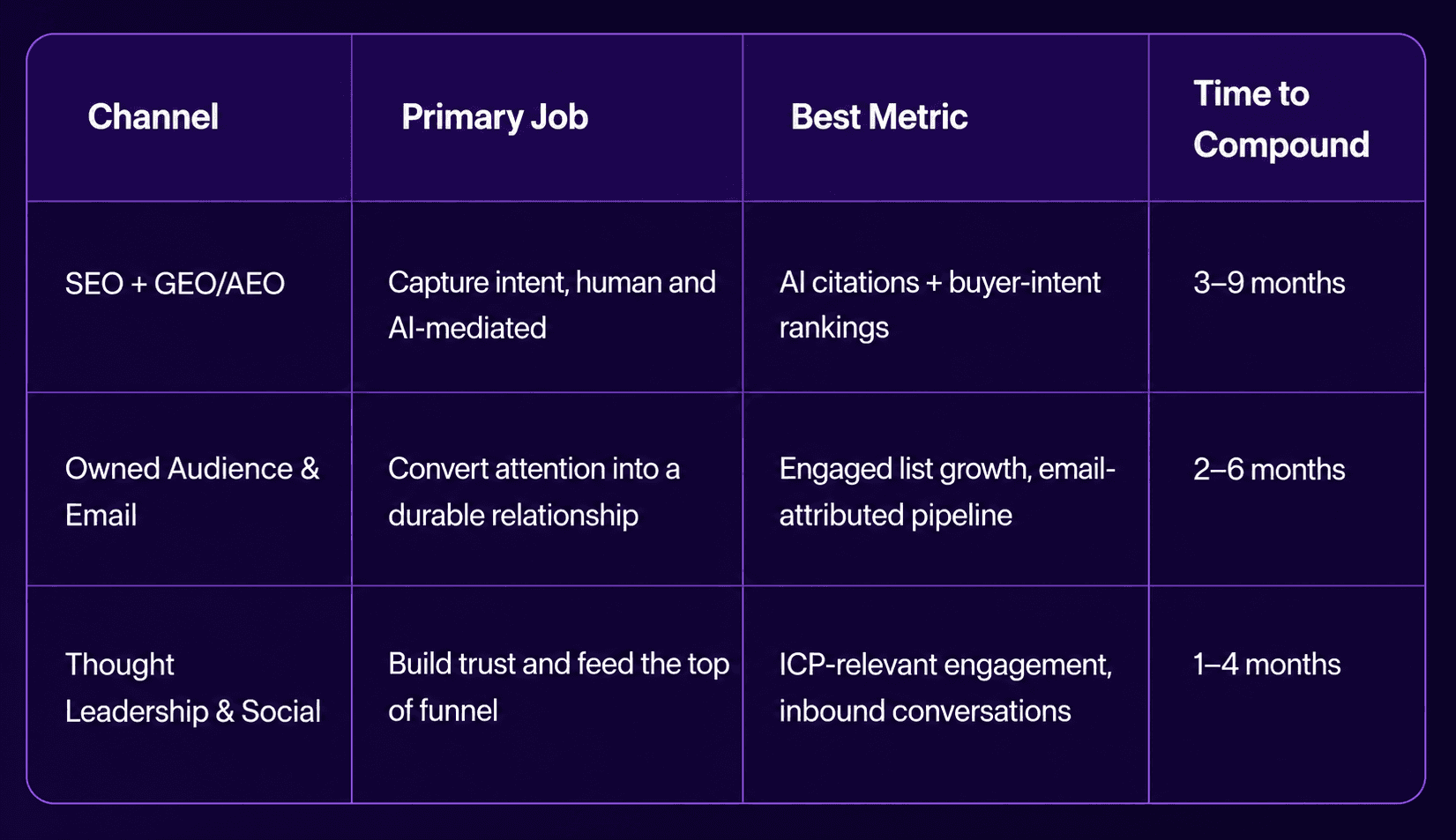
These channels aren't three separate strategies, they're one system. Organic and AI search visibility attracts and earns trust at the moment of intent. Email captures that attention into an owned, durable relationship. Thought leadership keeps your brand visible and credible in between purchase cycles, then feeds new traffic back into search and email.
Conclusion: Depth Beats Breadth
None of this means abandoning every other channel overnight, paid ads, events, and partnerships all still have a place in a mature demand generation strategy. But if you're a lean team trying to build sustainable pipeline generation in an AI-first buying landscape, the highest leverage sits in owning your search and AI visibility, owning your audience relationship through email, and owning a consistent, credible voice in public.
The teams that win in 2026 aren't the ones chasing every emerging platform. They're the ones who picked their three channels, went deep, and let the compounding do the work. That's the real B2B growth strategy underneath every "overnight success" story you'll see this year.
Your Buyers Are Searching, Will They Find You?
Let’s build a marketing strategy that drives visibility, trust and inbound leads.