How I Recovered a SaaS Company's Lead Pipeline After It Went Quiet?
Traffic was steady. Demo requests weren't. A closer look showed a funnel that was quietly leaking leads at every stage and a site migration that had made things worse without anyone noticing.
Resources
Aug 26, 2026
Author - Mohana J

The Problem
Visitors were showing up. Leads weren't.
The site had a healthy stream of organic visitors enough that, by traffic numbers alone, things looked fine. But demo requests told a different story. Week over week, a large volume of visits was producing only a trickle of qualified leads.
The content itself wasn't the core issue, it was thin in places and lightly disorganized, but not broken. The bigger problem was structural: the site had recently gone through a platform migration, and in the process, things had quietly broken without anyone catching it in time.
"We didn't change our content. We just changed platforms. Why would that hurt our leads?", a question I hear at the start of nearly every migration recovery project.
The honest answer: a migration isn't just a platform swap. Broken URLs, missing redirects, and lost metadata all quietly erase the trust signals search engines had built up over time and every one of those was present here.
The Diagnosis
A funnel with cracks at every stage
Once I dug in, three separate issues were compounding each other: technical damage from the migration was suppressing visibility, weak content structure was failing to build topical authority, and calls-to-action across the site weren't doing enough to move an interested visitor toward a demo request.
None of these alone would have caused this much of a drop. Together, they meant the funnel was leaking at the top, the middle, and the bottom all at once.
The Work
What I actually did, step by step
#1 Ran a full technical SEO audit
Crawled the entire site to catch broken links, crawl errors, and indexing issues, then mapped every URL affected by the migration to identify what needed to be restored first.
#2 Fixed the migration damage
Rebuilt redirects, restored lost metadata, and updated the sitemap to match the new site structure, then resubmitted everything for reindexing so search engines could rebuild trust in the site.
#3 Restructured content into topic clusters
Grouped related content around core commercial pages with clear internal linking, turning scattered posts into a structure that actually built topical authority.
#4 Rebuilt CTAs around buyer intent
Replaced generic, one-size-fits-all calls-to-action with intent-based CTAs matched to where a visitor actually was in their decision process, shifting the goal from passive engagement to demo requests.
The Outcome
From a leaking funnel to a working one
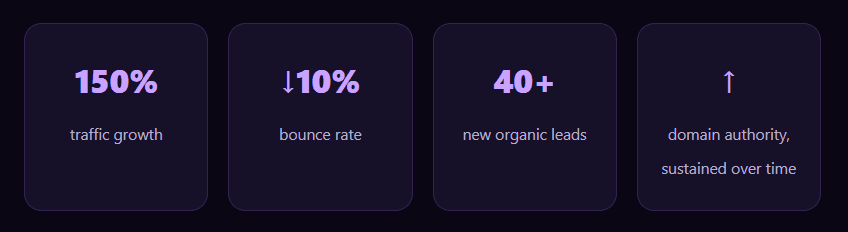
The recovery wasn't just about getting rankings back, it was about getting the whole funnel to hold together again. Traffic came back, and this time it converted.
The Insight
What this case study actually proves?
A lead-gen problem is rarely just a content problem or just a technical problem — it's usually both, compounding quietly until traffic and conversions both stall. Fixing only the visible symptom (weak content) without fixing the invisible one (technical damage) would have left the funnel just as broken.
Every redirect, every piece of lost metadata, every generic CTA is a small leak. Individually they seem minor. Together, they're the difference between a funnel that converts and one that just collects visits.
This recovery worked because it treated the funnel as one connected system such as technical health, content structure, and conversion design instead of patching each piece in isolation.
Your Buyers Are Searching, Will They Find You?
Let’s build a marketing strategy that drives visibility, trust and inbound leads.